Aller au contenu

Talks#

Quick links: Sessionize | Speaker Deck

The recording playlists are available here:

Not all sessions are listed here. I have already stopped giving most Jenkins talks, though I can refresh some on request. I also deliver specialized talks and workshops for different technology stacks and local meetups.

Browse by tag:jenkinsci-cdopen-sourcetestingwiremockapitestcontainerscommunityembeddeddeveloper-toolshardwarecultureinnersourceobservabilityaigradleautomationcloud-nativedockerjavakeptnlibrecoresmentorshipquarkussecurityconfiguration-as-codedependenciesdeveloper-relationsjenkinsfile-runnermockingopenapiopentelemetrypipelineprometheustroubleshootinganalyticsarchitecturecdeventschaosscode-coveragecppdatadata-sciencedevcontainersdeveloper-experiencedeveloper-productivitydocumentationfeature-flagsgithubgolanggrimoirelabkotlinkubernetesleadershipmanagementmicrocksmigrationopenfeaturepythonremotingslo

Management, Open Source and Culture#

  • Contributing to Jenkins, CDF and Google Summer of Code
    Getting started with Jenkins contributions and outreach programs, including Google Summer of Code.
    Tags:jenkinsopen-sourcecommunitymentorship

    Contributing to Jenkins, CDF and Google Summer of Code

    Contributing to Jenkins, CDF and Google Summer of Code

    Jenkins is a very diverse project with many opportunities to contribute and many technology stacks. Some examples: Java, JavaScript, Golang, Groovy, Docker, Kubernetes. And it is not only about code. We are also continuously looking for non-code contributions: documentation, testing, design, and spreading the word. We always welcome experienced and newcomer contributors to join the community.

    This presentations is an introduction to contributing to Jenkins, from code and testing to documentation and community outreach. The presentation also covers Google Summer of Code and other opportunities for newcomers to get involved.

    Presented by Oleg Nenashev, Mark Waite, Shivay Lamba, and other community members.

    Read more about my open source mentorship and my participation in Google Summer of Code.

    Tags:jenkinsopen-sourcecommunitymentorship

    Learn more

  • Guerilla Developer Relations. How to start DevRel and turn around the culture in a legacy enterprise company?
    Starting developer relations from scratch in a large enterprise, with no resources.
    Tags:developer-relationscommunitycultureinnersource

    Guerilla Developer Relations. How to start DevRel and turn around the culture in a legacy enterprise company?

    Guerilla Developer Relations. How to start DevRel and turn around the culture in a legacy enterprise company?

    Many developers care about the end-user experience, especially when those end users are fellow developers. But do their companies really care? Despite the product-led growth buzz, not everyone has a DevRel strategy beyond slides. “Top-to-bottom sales for the win,” “Let’s work with VPs,” they say. Can a single contributor turn around the culture and introduce developer relations in a big company? Maybe! Can they burn out in the process? Well, let's talk...

    We'll talk about setting up developer relations and an open communications culture in a rigid enterprise environment. How to get started without any resources? How to find allies and avoid making foes? What could possibly go right (sic!)? And how to actually make a difference and prove it? What is InnerSource, and how is it even related to this talk?

    Tags:developer-relationscommunitycultureinnersource

    Learn more

  • Mentorship programs for students in open source. Industry/Academia Partnerships
    Organizing mentorship programs in partnership between open source projects and universities, such as GSoC.
    Tags:mentorshipopen-sourcecommunityculture

    Mentorship programs for students in open source. Industry/Academia Partnerships

    Mentorship programs for students in open source. Industry/Academia Partnerships

    Mentorship and outreach programs are often considered side projects in both academia and the industry. Although they are a nice way to spend time and have some fun, one may say they rarely add new long-term contributors to a company project or a community, and that they are not always beneficial to students, especially on the Master and PhD level. Is this true?

    Let's talk about organizing mentorship programs in partnership between open source projects and universities. How such contributions help to grow your current community and contributors. How to involve students and higher education orgs into wider community efforts? And what can they get from it? Let's talk about various program types: from wide outreach programs like GSoC, individual mentorship programs or wide-reach programs like Hacktoberfest that can be leveraged by researchers. I will share some examples from my open source projects and Swiss universities, for example GSoC in the Free and Open Source Silicon foundation together with ETH Zurich.

    Read more about my open source mentorship and my participation in Google Summer of Code.

    Tags:mentorshipopen-sourcecommunityculture

    Learn more

  • Mentorship programs. Growing new team and community leaders
    Designing mentorship and outreach programs that grow maintainers and community leaders.
    Tags:communitymentorshipleadershipinnersource

    Mentorship programs. Growing new team and community leaders

    Mentorship programs. Growing new team and community leaders

    Mentorship and outreach programs are often considered as side projects. Although they are a nice way to spend time and have fun, one may say they rarely add new long-term contributors to your company project or community. Is it true? Is it even the main goal? Or is it about team bonding and growing new maintainers and community leaders?

    Let’s discuss how to organize mentorship programs that help grow your current community and contributors. How do we involve a contributor in broader community efforts? How do we help them grow and take on new roles? Let’s discuss various program types, including wide outreach programs such as GSoC or Hacktoberfest, newcomer assistance, focused maintainer mentoring programs, and individual leadership training like shadow officers.

    The talk is based on my experience in the Jenkins, FOSSi, the Continuous Delivery Foundation and other communities. I organized or helped to organize several mentorship and outreach programs: contributor/maintainer onboarding, GSoC/GSoD, Outreachy, CommunityBridge, various hackathons, and board member training.

    Read more about my open source mentorship and my participation in Google Summer of Code.

    Tags:communitymentorshipleadershipinnersource

    Learn more

  • Open roadmaps for your open communities. Not a success story, but you may have one
    Tips for building and maintaining an effective public roadmap, including mistakes made.
    Tags:communityopen-sourcemanagementinnersource

    Open roadmaps for your open communities. Not a success story, but you may have one

    Open roadmaps for your open communities. Not a success story, but you may have one

    As open source projects and communities grow, it becomes difficult to understand what’s going on inside. A public and up-to-date roadmap can encourage new contributors to join the project and guide the efforts of existing contributors, and also give confidence to adopters about the direction and sustainability of the projects. Is it easy to create a public roadmap? Probably. Is it easy to maintain it? Not exactly. Did we fail with it? Yes.

    Oleg will share the experiences of public roadmaps in the projects he has contributed to: Jenkins, WireMock, Keptn, CDF, etc. He'll share the reasons and principles that have guided creation of open roadmaps, the challenges encountered, the techniques and technologies that could be used in your projects. We’ll talk about maintaining roadmaps, mistakes we made there and how we addressed them.

    In particular, Oleg will describe building a roadmap with help of GitHub Projects and modern features offered by the GitHub ecosystem. That could be the easiest way for new projects and communities, and can be also useful for established projects.

    The Ignite version is a short introduction with several tips about building an effective public roadmap for your project.

    Tags:communityopen-sourcemanagementinnersource

    Learn more

  • Wood, Water, Communities - Toastmasters Icebreaker
    A short self-introduction about the importance of local and global communities.
    Tags:communityculture

    Wood, Water, Communities - Toastmasters Icebreaker

    Wood, Water, Communities - Toastmasters Icebreaker

    Just a small first presentation and self-introduction for Lakeshore Speakers - a local Toastmasters club. There, I focused on the importance of local and global communities, and how individual participants can benefit from them.

    Tags:communityculture

    Learn more

AI#

  • Bottom-up AI enablement while improving DevEx and collaboration
    Introducing AI enablement, InnerSource, and developer productivity through bottom-up collaboration.
    Tags:innersourcecultureaideveloper-productivity

    Bottom-up AI enablement while improving DevEx and collaboration

    Many developers care about collaboration, AI enablement, and developer productivity. But do their companies really care? Despite the endless DevOps and developer productivity slide decks, not everyone has a strategy beyond “let’s buy a ChatGPT subscription and call us AI-first” or a classic “let’s have another weekly meeting” from management. Can a single engineer actually introduce InnerSource and get nice things tools to teams in a big enterprise? Maybe!

    We’ll discuss setting up InnerSource and an open contribution culture inside rigid corporate structures that are not willing to change. We all try to change companies first, and in 2025-2026, the ongoing AI hype can be a great leverage - a universal justification to form internal guilds, secure funding, and get executive attention for collaboration and productivity initiatives.

    How to get started without a budget or official blessing? How to find allies and not burn too many bridges? What could possibly go right (sic!)? And how to show impact when everyone’s so obsessed with KPIs?

    Upcoming

    • InnerSource Commons Community Call, November 2026

    Tags:innersourcecultureaideveloper-productivity

    Learn more

  • d'AIrtagnan and Three Mocketeers for easy integration testing - all as one, and one as all
    Generating integration testing services and mocks with AI, Testcontainers, Microcks, and DataFaker.
    Tags:aitestingmockingtestcontainerswiremockmicrocksquarkus

    d'AIrtagnan and Three Mocketeers for easy integration testing - all as one, and one as all

    When you model (aka "mock") services during software development or integration testing, you need to mimic APIs, databases, and other data providers. You can't do this with just one tool; you need to combine several. You will also need zillions of configuration files and test samples for mocks... unless you leverage the power of Generative AI. Can we make it hallucinate productively without breaking the vibe of actual development?

    In this live session, I'll show you how to create test services, mock databases, and API providers using Testcontainers, Microcks, and DataFaker for a modern Android/Gradle project. After the introduction, we'll skip all the boring YAML configurations and go straight to leveraging AI and MCPs to generate proper data services and mocks with minimal effort from the developer's side.

    Tags:aitestingmockingtestcontainerswiremockmicrocksquarkus

    Learn more

  • Gradle Build Tool for Agentic World, NOW!
    Exploring Gradle Build Tool as a build server for interactive, agentic development.
    Tags:gradleaideveloper-tools

    Gradle Build Tool for Agentic World, NOW!

    The way we build software is changing, and agents are rising! CI systems have already evolved from brittle shell-script runners to highly resilient, feature-rich services that support developers at every step, from a new branch in the IDE to deployment. The same happens with build tools. In five years, we won’t be running mvn clean package or gradle build. Instead, developers or AI agents will interact with build servers in dialog mode. So, bye-bye “software builds” and welcome “software transforms” powered by build servers?

    This talk introduces the great old Gradle Build Tool but re-packaged for the new world where developers don’t just write tasks—they collaborate with the build server directly, or let their agentic system do that. We’ll explore how Gradle’s existing capabilities—its Daemon Mode, advanced build and configuration caching, Tooling API, Build Server Protocol integrations, MCP servers & Co make it not just a Build Tool, but a Build Server suitable for iterative agentic development!

    You’ll see live examples of agentic workflows in action, including conversational build interactions from within IDEs like Visual Studio Code or IntelliJ IDEA, interactive dependency updates and toolchain management. Everything I present will be open source and ready for tinkering in your projects.

    Tags:gradleaideveloper-tools

    Learn more

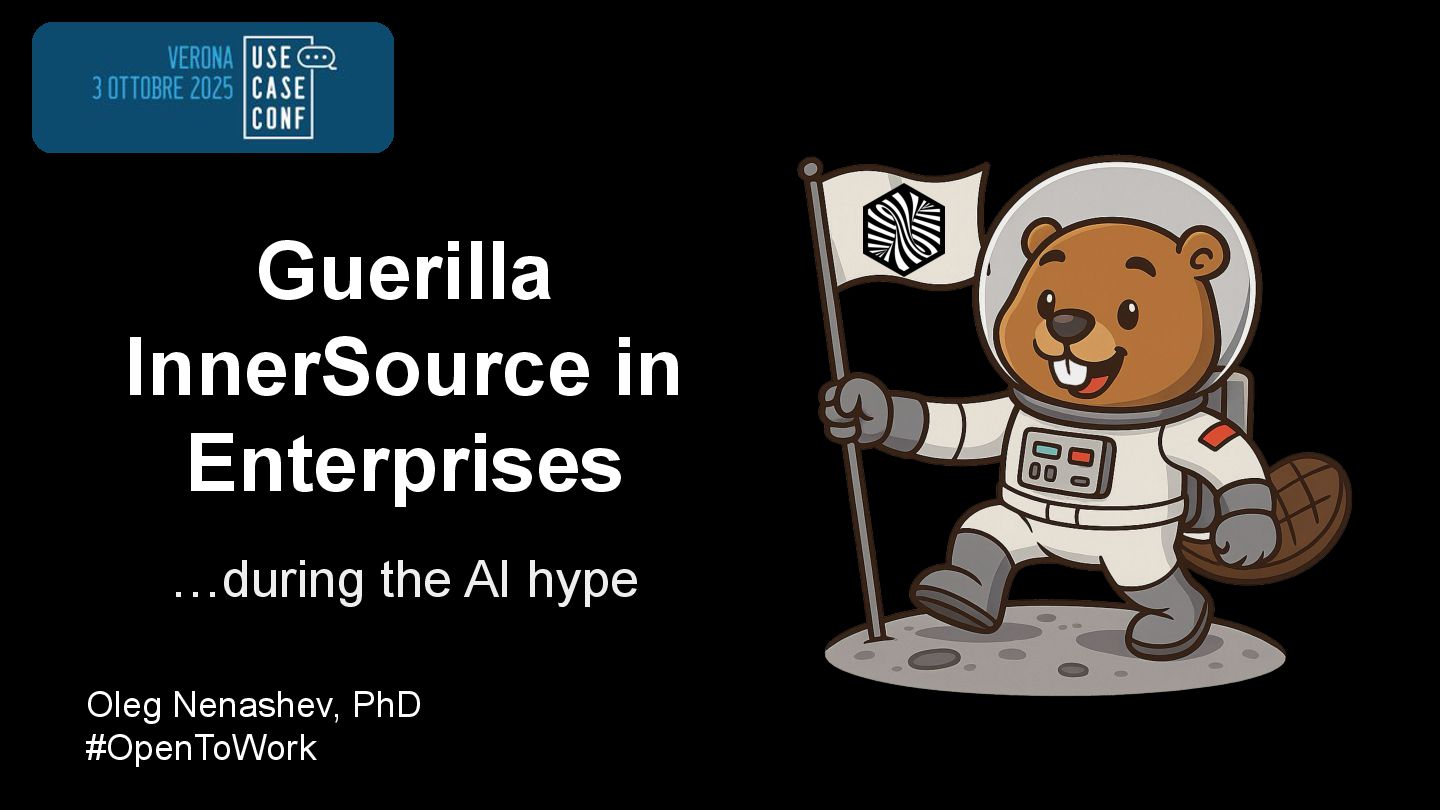
  • Guerilla InnerSource in enterprises, during the AI hype
    Introducing InnerSource and an open collaboration culture in a rigid enterprise, using the AI hype as leverage.
    Tags:innersourceculturedeveloper-relationsai

    Guerilla InnerSource in enterprises, during the AI hype

    Guerilla InnerSource in enterprises, during the AI hype

    Many developers want to foster collaboration, knowledge sharing, and developer productivity—especially when those developers are their own colleagues. But do their companies really care? Despite the endless DevOps and developer productivity slidedecks, not everyone has a strategy beyond "let's form another task force" or "let's have another weekly meeting" from management. Can a single engineer actually introduce InnerSource and change how work gets done in a big enterprise? Maybe! Can they burnout in the process? Well, let's talk...

    We'll discuss introducing an open collaboration culture, also known as InnerSource, into rigid corporate structures that aren't willing to change. The ongoing AI hype can be a great leverage—an excuse to form internal guilds, secure funding, and get executive attention for collaboration and productivity initiatives. How to get started without a budget or official blessing from higher ups? How to find allies and not burn too many bridges? And how to show impact when everyone's obsessed with KPIs?

    Tags:innersourceculturedeveloper-relationsai

    Learn more

WireMock and Testcontainers#

  • Advanced Code Coverage with Jenkins and API Mocking
    Improving code coverage reporting in Jenkins and GitHub, with API mocking to test the hard-to-reach paths.
    Tags:jenkinstestingcode-coveragewiremocktestcontainers

    Advanced Code Coverage with Jenkins and API Mocking

    Advanced Code Coverage with Jenkins and API Mocking

    In 2015-2018, I talked about how to use the Jenkins Pipeline and custom libraries to do advanced integration tests and analyze code coverage. Coverage plugins were rather weak, and one needed some scripts and hacks to make it work, and to DIY for distributed testing. In 2021 the situation has changed significantly thanks to the Coverage and Checks API plugins. Distributed integration testing also became easier thanks to better coverage collectors and integrations with API mocking tools. So, good time to be alive… and use Jenkins!

    We will talk about how modern Jenkins allows you to improve and analyze code coverage. We will talk about unit and integration testing with WireMock, the new Coverage Plugin, support for standard formats (Cobertura, JaCoCo, gcov, JUnit, etc.), parallelization for heavy integration tests and API mocking, and integration with GitHub Checks API. How can you analyze code coverage in Jenkins and when do you need to create your own libraries? And what’s the fuzz about Testcontainers and WireMock for integration testing?

    Tags:jenkinstestingcode-coveragewiremocktestcontainers

    Learn more

  • API Integration Testing of Embedded projects with Testcontainers and WireMock
    Using Testcontainers and WireMock for API integration tests in C/C++ embedded projects.
    Tags:embeddedtestingapiwiremocktestcontainers

    API Integration Testing of Embedded projects with Testcontainers and WireMock

    API Integration Testing of Embedded projects with Testcontainers and WireMock

    Embedded software engineers can have nice things, too! Overview of Testcontainers and WireMock usage for C/C++ projects.

    Tags:embeddedtestingapiwiremocktestcontainers

    Learn more

  • Developing subatomic apps with Quarkus and WireMock
    Live coding a REST and gRPC 3-tier app with Quarkus Dev Services, WireMock and Testcontainers.
    Tags:wiremocktestcontainersmockingapi

    Developing subatomic apps with Quarkus and WireMock

    Developing subatomic apps with Quarkus and WireMock

    Quarkus has a lot of capabilities for local development, including the recently released Dev Services that usually runs with Testcontainers under the hood. We can leverage Dev Services for providing great real-time API provider development experiences for Quarkus based service and client apps.

    In this talk and live coding session I will show how to develop a REST API and gRPC 3-tier client-service-database app with help of WireMock, Quarkus and Testcontainers. We will go through live development and prototyping APIs, mocking data and API providers, and then also using WireMock as a proxy to inject some failures and chaos into the service.

    Tags:wiremocktestcontainersmockingapi

    Learn more

  • Fake it until you `make it`. API integration testing with Testcontainers and WireMock
    Choosing between Testcontainers and WireMock for API integration tests, and combining them.
    Tags:testingapiwiremocktestcontainers

    Fake it until you `make it`. API integration testing with Testcontainers and WireMock

    Fake it until you `make it`. API integration testing with Testcontainers and WireMock

    Testcontainers has become one of the most popular tools for software integration testing. If you can put your system-under-test into a container, Docker compose cluster or a pod, this is what you're likely to use. If your target isn't ready, not containerizable or just too heavy for testing as is, you can always use mock testing frameworks, e.g. WireMock or MockServer in the JVM ecosystem. Can you combine both approaches? Sure!

    In this talk, we will classify integration testing and discuss application areas for WireMock and Testcontainers, and discuss which tool to choose for each use-case. And why not both? We will discuss putting WireMock into Testcontainers, and getting the best from their features thanks to the new WireMock modules for Testcontainers. Last but not least, we will see how to put WireMock in front of the Testcontainers or your real system to do deeper tests or even chaos engineering.

    P.S: We will focus on the Java, Golang or Rust examples, but the same approaches can be used everywhere

    Tags:testingapiwiremocktestcontainers

    Learn more

  • Leveraging Kotlin and Gradle Build Tool in your Java project - story of WireMock
    How WireMock uses Kotlin and Gradle Build Tool to improve contributor productivity.
    Tags:javakotlingradlewiremockdeveloper-tools

    Leveraging Kotlin and Gradle Build Tool in your Java project - story of WireMock

    Leveraging Kotlin and Gradle Build Tool in your Java project - story of WireMock

    Le projet WireMock et sa communauté de développeurs se développent rapidement. Alors, nous avons besoin d'outils de développement appropriés pour offrir la meilleure expérience de développement possible à nos principaux utilisateurs finaux et contributeurs. WireMock utilise Gradle Build Tool depuis longtemps, et nous adoptons Kotlin comme langage pour le développement d'extensions et les définitions de build. Même langage pour les développeurs pour le code d'extension, les scripts WireMock et les définitions de build? Ce serait cool!

    Dans cette présentation, je vais expliquer comment nous utilisons et prévoyons d'utiliser Kotlin et Gradle Build Tool pour améliorer la productivité des développeurs. Nous allons discuter de Kotlin DSL pour WireMock, des Gradle Build Tool convention plugins pour le logiciel de builds partagés, du développement d'extensions de WireMock en Kotlin et de ses DSL bindings. Je vais utiliser les exemples de WireMock qui sont open source et disponibles sur GitHub.

    Gradle®, Develocity®, Build Scan®, and the Gradlephant logo are registered trademarks of Gradle, Inc. "Gradle" means "Gradle Build Tool" and does not reference Gradle, Inc. and/or its subsidiaries.

    Tags:javakotlingradlewiremockdeveloper-tools

    Learn more

  • Strange Quarks, Mocking Quarks - Modeling API services in Quarkus in high-density environments
    Developing and mocking APIs with Quarkus Dev Services and WireMock in Gradle projects.
    Tags:quarkuswiremocktestcontainersapitesting

    Strange Quarks, Mocking Quarks - Modeling API services in Quarkus in high-density environments

    Strange Quarks, Mocking Quarks - Modeling API services in Quarkus in high-density environments

    Quarkus offers many local development capabilities, including the recently released Dev Services that usually run with Testcontainers under the hood. We can leverage Dev Services to provide real-time API provider development experiences for Quarkus-based services and client apps.

    In this session, I provide an overview of using Quarkus and its Dev Services in Gradle projects. We take WireMock as an example. I will demonstrate how to develop a REST API and a gRPC 3-tier client-service-database application using Quarkus and WireMock. DM for a Testcontainers edition!

    NOTE: This presentation was modified on Oct 10, 2025, to exclude the IP of Gradle Inc. Extended introduction, Quarkus Plugin for Gradle Build Tool, and the respective demo details are no longer included in the slides.

    Gradle®, Develocity®, Build Scan®, and the Gradlephant logo are registered trademarks of Gradle, Inc. "Gradle" means "Gradle Build Tool" and does not reference Gradle, Inc. and/or its subsidiaries.

    Tags:quarkuswiremocktestcontainersapitesting

    Learn more

  • Testcontainers and API mocking for Golang projects
    Using Testcontainers and WireMock for integration testing in Go projects.
    Tags:golangtestingapiwiremocktestcontainers

    Testcontainers and API mocking for Golang projects

    Testcontainers and API mocking for Golang projects

    Testcontainers has become one of the most popular tools for software integration testing. If you can put your system-under-test into a container, Docker Compose cluster, or a pod, this is what you're likely to use. If your target isn't ready, not containerizable, or just too heavy for testing as is, you can always use API mocking like WireMock or Microcks to mock your interfaces including REST API, gRPC, etc.

    In this talks, I will focus on using WireMock and Microcks for cloud native projects implemented in Golang, including using it for common continuous delivery and deployment use-cases. We will see how to use Testcontainers and its API mocking modules as a standalone deployment, or as a part of Argo CD and Tekton pipelines. And then, let's see how to seamlessly use the same tools in Golang IDEs!

    The Speaker Deck version is a quick overview of Testcontainers for integration testing in Golang projects, with WireMock as an example.

    Tags:golangtestingapiwiremocktestcontainers

    Learn more

  • Testcontainers and API mocking with WireMock for C/C++ projects
    Testcontainers for C/C++: an SDK for integration testing native projects with WireMock.
    Tags:cppembeddedtestingwiremocktestcontainers

    Testcontainers and API mocking with WireMock for C/C++ projects

    Testcontainers and API mocking with WireMock for C/C++ projects

    Testcontainers has become one of the most popular tools for software integration testing. If you can put your system-under-test into a container, Docker compose cluster or a pod, this is what you're likely to use. If your target isn't ready, not containerizable or just too heavy for testing as is, you can always use API mocking like WireMock to mock your interfaces including REST API, gRPC, etc. But are these tools available to C/C++ developers? And the answer is YES!

    In September 2023 I created Testcontainers for C/C++. This is not a standalone Testcontainers engine, but a C-style shared library adapter for native languages like C/C++, and also D, Lua, Swift, etc. It is a MVP SDK that can be later extended for the languages. The project is based on Testcontainers for Go which is one of the most powerful Testcontainers implementations. And yes happy to chat about how it does [and doesn’t] work under the hood.

    The objective of this talk is to present the existing solution, find early adopters and get feedback from professional C/C++ developers who use modern C/C++. For me it has been 10 years since I used it professionally for Embedded and SCADA projects, so it would be awesome to get the community feedback on use-cases and priorities!

    Tags:cppembeddedtestingwiremocktestcontainers

    Learn more

  • Want a cup of Java? API and data mocking for Python projects
    Testing Python data pipelines against mocked services and fake data with Testcontainers and WireMock.
    Tags:pythontestingapidatawiremocktestcontainers

    Want a cup of Java? API and data mocking for Python projects

    Want a cup of Java? API and data mocking for Python projects

    When working in embedded and observability domains, I’ve used Python scripting to retrieve and pre-process data from external sources, and one of the issues I’ve seen is the difficulty to reliably test data pipelines against external services: API limits and pay-per-use costs, service outages, etc, etc. So, can we model (aka “mock”) the services to reliably test our data ingestion pipelines?. Sure we can!

    In this talk I will show a few ways to build test services, databases and API providers with the help of Testcontainers and WireMock available on Python, thanks to container tech. Then, we will extend the approach by adding the generation of fake data with help of Faker libraries or Synthesized that can be used for both relational data and data sequences.

    Tags:pythontestingapidatawiremocktestcontainers

    Learn more

  • WireMock8s - Mocking your APIs in Kubernetes
    Running WireMock on Kubernetes for API mocking in cloud-native testing and pipelines.
    Tags:wiremockkubernetesapitesting

    WireMock8s - Mocking your APIs in Kubernetes

    WireMock8s - Mocking your APIs in Kubernetes

    Distributed and microservice architectures are all about APIs these days, whether you use gRPC, REST API, Websockets or any other interface. There are tools for integration testing that involve API providers, including mocking them based on OpenAPI specifications. There are even Kubernetes native tools like Microcks that are scalable and provide valuable features and observability out of the box. More classic tools, including my favorite WireMock, are available on Kubernetes too.

    If you’ve ever developed for JVM or .NET stacks, most likely you’ve heard about WireMock. It is a popular open-source tool and framework for API mock testing, with over 5 million downloads per month. It has implementations and adapters for many languages.

    In this talk, I will focus on using WireMock for testing Cloud Native applications in Kubernetes, including using it for common continuous delivery and deployment use-cases. We will see how to use WireMock as a standalone deployment, or as a part of Argo CD and Tekton pipelines. I’ll also show how these approaches can be integrated with WireMock Cloud for those who want to do distributed testing and chaos engineering.

    Tags:wiremockkubernetesapitesting

    Learn more

Jenkins#

  • [R]Evolution of open-source CI/CD tools
    How open-source CI tools evolved from monoliths to cloud-native building blocks.
    Tags:open-sourceci-cddeveloper-toolsjenkins

    [R]Evolution of open-source CI/CD tools

    [R]Evolution of open-source CI/CD tools

    How do Open Source and DevOps cultures impact Continuous Integration (and maybe not CD for once)? "Open source is eating the world". The same happens with the automation tools domain, including CI. There are many open source CI tools or open ecosystems on the market: Jenkins, Dagger, Argo projects, GitLab CI, Tekton, Dagger, GitHub Actions, etc., etc. There are many generations of these tools, with their architectures and use cases. We will talk about these tools and their evolution, from monolith services to cloud-native CI and Linux-way split to building blocks and interoperability.

    What changed since CI was introduced 20 years ago? How do Open Source, InnerSource, and DevOps impact the landscape? What's next for the tools: cloud-native environments, machine learning, etc.? And how do open source foundations and other collaborations participate in the evolution of open source tools and facilitate it?

    Tags:open-sourceci-cddeveloper-toolsjenkins

    Learn more

  • Automating Hardware/Embedded Projects with Jenkins
    Using Jenkins for CI and delivery in open-source hardware and FPGA projects.
    Tags:jenkinsembeddedhardwareci-cd

    Automating Hardware/Embedded Projects with Jenkins

    Automating Hardware/Embedded Projects with Jenkins

    Jenkins is one of the leading open-source automation servers. It’s a framework, which can be adjusted to a particular area with help of its flexibility and plugin system. Many open-source hardware and embedded projects build their Continuous Integration and Delivery flows with Jenkins, because there is not so many tools in the area.

    In the talk I would like to cover common use-cases of Jenkins in hardware projects like integration with EDA tools and hardware peripherals like FPGAs and reporting of build, test and coverage reports. After that I’ll share one of two case studies about integration of Jenkins into hardware projects. If I achieve something presentable with the ongoing project by the conference, one of the case studies will be about FuseSoC integration with Jenkins.

    Tags:jenkinsembeddedhardwareci-cd

    Learn more

  • CDEvents in Jenkins and Keptn. What's next?
    How CDEvents is used in Jenkins and Keptn, and where the standard goes next.
    Tags:jenkinskeptncdeventsci-cd

    CDEvents in Jenkins and Keptn. What's next?

    CDEvents in Jenkins and Keptn. What's next?

    Overview of CDEvents from the standpoint of external adopter, and also plans for adopting CDEvents in Jenkins and Keptn. This talk was delivered together with Shruti Chaturvedi's GSoC project update on support for CloudEvents/CDEvents in Jenkins, at Kubecon | CloudNativeCon EU 2022

    Read more about my participation in Google Summer of Code.

    Tags:jenkinskeptncdeventsci-cd

    Learn more

  • Cloud Friendly(?) Jenkins. How we failed to make Jenkins cloud native and what we learned
    What worked and what failed when making Jenkins cloud native, and why cloud friendly is enough.
    Tags:jenkinscloud-nativearchitectureci-cd

    Cloud Friendly(?) Jenkins. How we failed to make Jenkins cloud native and what we learned

    Cloud Friendly(?) Jenkins. How we failed to make Jenkins cloud native and what we learned

    Key takeaway: Being Cloud Friendly is a must, Cloud Native is optional. Likely YAGNI in your projects

    Jenkins has been one of the most popular automation servers in the world. It is widely used for CI/CD purposes in cloud environments. You may have heard that Jenkins is not cloud native, and of course it is true. You may have heard that Jenkins controllers are a legacy monolith from the 2000s. That is not true, it is quite cloud friendly if used right. And yes we tried to make Jenkins cloud native, but it didn’t quite work. Why?

    I have been involved in Jenkins architecture projects for more than ten years, including pluggable storage, multi-tenant Jenkins, cloud-native agents, breaking down the controller monolith, Kubernetes integrations, etc. Some of these efforts worked, some didn’t. But it was a great learning experience that can be used by developers and maintainers of other projects that consider re-platforming them to make cloud- and Kubernetes-native. I'll talk about the technical assumptions and mistakes we made in Jenkins, and how it worked. What to keep in mind when doing the re-platforming? And do you even need it?

    Tags:jenkinscloud-nativearchitectureci-cd

    Learn more

  • Common Pitfalls in Jenkins Security and How to Avoid Them
    The most common Jenkins security mistakes and how to avoid them.
    Tags:jenkinssecurity

    Common Pitfalls in Jenkins Security and How to Avoid Them

    Common Pitfalls in Jenkins Security and How to Avoid Them

    It is 2025, and Jenkins, an open source automation server with 20 years of history, still dominates the CI/CD market and remains a mission-critical part of the worldwide software supply chain. In 2025, it even won the "The most innovative DevOps open source project" award from DevOps Dozen, and got security grants from Alpha Omega. But Jenkins still has quite an old architecture, and one can consider it a remote execution engine which has access to project data… by design. So, how secure is your instance and supply chain when using Jenkins?

    When it comes to Jenkins instances with thousands of users, it is hard to retain status quo between security itself and its impact on user experience due to the restrictions and performance degradation. I will talk about Jenkins security model, best practices and common non-newbie configuration mistakes which we often see on production instances. In particular we will discuss Groovy scripting, controller-to-agent communications and resource isolation. We will also review a few supply chain attack cases that happened through Jenkins, and how one could prevent them.

    Target audience for this talk: experienced Jenkins administrators and users interested in Security. The learnings are applicable to other CI/CD tools, especially the self-hosted ones

    Tags:jenkinssecurity

    Learn more

  • Dependabot for Jenkins plugin development
    Automating dependency updates with Dependabot, based on the Jenkins experience.
    Tags:jenkinsdependenciesautomation

    Dependabot for Jenkins plugin development

    Dependabot for Jenkins plugin development

    What is common between Maven, NPM or RPM? It is dependency hell. Continuously updating dependencies is a significant overhead. If you do not do that, any next major update might be a problem for you. It is exactly what we hit while adding Java 11 support to Jenkins. What if we delegate such routine work to a bot? In our project we chose Dependabot, and in this talk I would like to do a brief introduction to the tool.

    Tags:jenkinsdependenciesautomation

    Learn more

  • Docker and Jenkins [as Code]
    Running Jenkins in Docker and managing its configuration as code.
    Tags:jenkinsdockerconfiguration-as-codeci-cd

    Docker and Jenkins [as Code]

    Docker and Jenkins [as Code]

    Docker is everywhere in the CI/CD pipelines and in development tools. Jenkins, one of the most popular automation servers, is actively evolving to improve its support of container technologies and static configurations in images. The Configuration as Code plugin is a new milestone which enables managing Jenkins configurations via YAML. Together with Docker, this plugin offers many ways to produce ready-to-fly Jenkins images for any environments. In our talk, we will describe official master and agent images offered by the Jenkins project. What's inside them? How do you configure images with JCasC and Groovy hooks? How do you use these approaches together? How do CloudBees Jenkins Distribution and CloudBees Assurance program help with plugin management? And what's next for Jenkins Docker packaging and JCasC?

    Tags:jenkinsdockerconfiguration-as-codeci-cd

    Learn more

  • External Build Logging in Jenkins. Prototype Demo
    Pluggable Log storage prototype - integrating with Logstash and Elasticsearch instead of the disk.
    Tags:jenkinsobservabilityci-cd

    External Build Logging in Jenkins. Prototype Demo

    External Build Logging in Jenkins. Prototype Demo

    This presentation summarizes results of our project from the Jenkins World 2016 hackathon. The prototype implements reporting of build logs to Logstash/Elasticsearch instead of the system disk and their further visualization within the Jenkins Web UI.

    The approach allows to reduce network and IO load on Jenkins master and thus avoid performance bottlenecks on large-scale instances.

    Tags:jenkinsobservabilityci-cd

    Learn more

  • How to develop your Jenkins Pipeline locally?
    Editing and testing Jenkins Pipeline libraries locally with Configuration-as-Code and Docker.
    Tags:jenkinspipelinedockerconfiguration-as-code

    How to develop your Jenkins Pipeline locally?

    How to develop your Jenkins Pipeline locally?

    If you have ever tried developing Pipeline Libraries in Jenkins, you may have noticed how long it takes to deploy a new version to server to discover just another syntax error. I will show how to edit and test Pipeline libraries locally before committing to the repository (with Configuration-as-Code and Docker).

    Tags:jenkinspipelinedockerconfiguration-as-code

    Learn more

  • Jenkins 2022 and Beyond
    The state of Jenkins in 2022 and where the project is heading.
    Tags:jenkinsci-cdopen-source

    Jenkins 2022 and Beyond

    Jenkins 2022 and Beyond

    Is the Butler Still Young? Maybe not but it is still one of the most popular automation tools. Jenkins in 2022 is not Jenkins in 2012. It keeps evolving to address demands from its users and contributors: pipeline as code, configuration as code, better support for cloud environments, UX, etc. We are looking forward to the next major iteration in Jenkins evolution. So what’s next for it? I will focus on the current challenges for Jenkins. What does need to change in the project and the community to keep it relevant? We will talk about revitalizing the community and attracting new company contributors, consolidating user experiences, and reusing experiences of BlueOcean and Jenkins X? We will also talk about interoperability with other projects, making Tekton a first class citizen Pipeline engine, and making Jenkins available everywhere regardless of CI/CD system you actually use.

    Tags:jenkinsci-cdopen-source

    Learn more

  • Jenkins Pipeline @ Scale. Building Automation Frameworks for Systems Integration
    Lessons learned from using Jenkins Pipeline to build automation frameworks for embedded systems integration.
    Tags:jenkinspipelineembeddedci-cd

    Jenkins Pipeline @ Scale. Building Automation Frameworks for Systems Integration

    This is a follow-up presentation to my talk at CloudBees | Jenkins Automotive and Embedded Day 2016, where I was presenting Pipeline usage strategies for use-cases in the Embedded area.

    In this presentation I talk about Jenkins Pipeline features for automation frameworks and talk about lessons learned in several projects.

    Tags:jenkinspipelineembeddedci-cd

    Learn more

  • Jenkins Remoting. Dealing with agent connectivity issues
    How Jenkins Remoting works, how to diagnose agent connection problems and where this layer is heading.
    Tags:jenkinsremotingtroubleshooting

    Jenkins Remoting. Dealing with agent connectivity issues

    Jenkins Remoting. Dealing with agent connectivity issues

    Welcome to the Dark side of Jenkins...

    Almost all agent types in Jenkins use the Remoting library to communicate with the master, including JNLP and SSH agents. Although Jenkins’ ability to run tasks on multiple hosts is one of its success factors, agent connection stability is known to be a major pain point in large-scale installations. In this workshop, the talk is about remoting internals, how to diagnose issues, how to configure Jenkins and underlying infrastructure, and the future of this layer in Jenkins.

    Tags:jenkinsremotingtroubleshooting

    Learn more

  • Jenkins-Based Continuous Integration for Heterogeneous Hardware/Software Projects
    Overview of Jenkins-based CI for embedded systems with both hardware and software components.
    Tags:jenkinshardwareembeddedci-cd

    Jenkins-Based Continuous Integration for Heterogeneous Hardware/Software Projects

    Jenkins-Based Continuous Integration for Heterogeneous Hardware/Software Projects

    This talk addresses Jenkins-based continuous integration (CI) in the area of embedded systems, which include both hardware and software components. An overview of common automation cases, challenges and their solutions based on Jenkins CI services will be presented. The specifics of Jenkins usage in the hardware area (available plugins and workarounds, environment and desired high availability features) is also covered.

    Tags:jenkinshardwareembeddedci-cd

    Learn more

  • Leap from Java 8 to Java 11 in Jenkins. Our *.war story
    Lessons from adding Java 11 support to Jenkins while keeping Java 8 compatibility.
    Tags:jenkinsjavamigration

    Leap from Java 8 to Java 11 in Jenkins. Our *.war story

    Leap from Java 8 to Java 11 in Jenkins. Our *.war story

    Jenkins, one of the leading open-source automation servers, has not been supporting Java 9 and above since its official release. Over the last year Jenkins contributors were working towards the support of Java 11 (Jenkins JEP-211). Jenkins has a huge and sometimes legacy Java/Groovy/native codebase, includes DSL engines, and depends on many upstream libraries and modules (including ones deleted from Java 11). It was a thorny way, but Java 11 support is almost ready to be released.

    In this talk I would like to share our experiences and talk about potential obstacles others may hit while implementing Java 11 support in their projects. What issues have we hit while implementing support of Java 11 in the core? Are modules and deprecations that tricky for a web application (spoiler: no)? How have we enabled building and testing with OpenJDK 11 in our Maven-based pipelines? And how have we retained Java 8 compatibility after all these changes?

    Tags:jenkinsjavamigration

    Learn more

  • Managing Embedded System test infrastructures with Docker and Jenkins
    When and how to use Docker and Jenkins in embedded and hardware-in-the-loop testing.
    Tags:embeddeddockerjenkinstestinghardware

    Managing Embedded System test infrastructures with Docker and Jenkins

    Managing Embedded System test infrastructures with Docker and Jenkins

    Virtualization and Containerization are one of the hottest areas in the test automation of software systems.

    Such approaches simplify management of test environments, reduce costs and improve reproducibility of tests.

    Docker is one of the popular container platforms in the area.

    Are such approaches applicable to the Embedded Systems area?

    Container technologies have limitations, especially when it comes to tests involving hardware-in-the-loop (HWIL) in the loop or drivers.

    In test automation flows it is important to know Docker limitations to properly combine it with other approaches.

    This talk focuses on Docker usage specifics in simulation-based and HWIL test automation with Docker and automation servers like Jenkins.

    The talk includes overview of Docker advantages and disadvantages, and provides examples from real-world projects.

    Main takeaways from the talk are the recommendations when and how to use Docker in Embedded Systems testing.

    And how to migrate the automation flows to such new approaches.

    Tags:embeddeddockerjenkinstestinghardware

    Learn more

  • Managing Jenkins Security
    Introduction to Jenkins security and best practices for administering large instances, including ownership-based security.
    Tags:jenkinssecurity

    Managing Jenkins Security

    Managing Jenkins Security

    In this presentation you can find introduction to Jenkins security and overview of best practices of administering Jenkins instances at scale.

    There is also a short overview of the Ownership-based Security engine which has been developed by me in order to manage Jenkins instances with hundreds of active users.

    Tags:jenkinssecurity

    Learn more

  • Under the hood of serverless Jenkins. Jenkinsfile Runner
    Running Jenkins Pipelines in single-shot containers with Jenkinsfile Runner.
    Tags:jenkinsci-cdcloud-nativejenkinsfile-runner

    Under the hood of serverless Jenkins. Jenkinsfile Runner

    Under the hood of serverless Jenkins. Jenkinsfile Runner

    There were significant changes in the Jenkins project over last year. It is still one of the most popular automation servers in the world, but it is not just a “server” anymore. In 2019 Jenkins is a universal automation engine, which actively evolves towards the new Cloud Native architecture and which can be used in any CI/CD flows. It can be used not only as a server, but also as a “serverless” single-shot execution. And it is not only about Jenkins X, but also about more classic usages.

    In my talk I will present Jenkinsfile Runner - an engine which allows running Jenkins Pipelines in a single-shot container. I will show how it is used in Jenkins X, GitHub Actions and other services. And, finally, I will show how to package your own Jenkinsfile Runner images and run it in any environments, CI systems and Cloud providers.

    NOTE: This slidedeck will be periodically updated to reflect the latest version of the talk

    Tags:jenkinsci-cdcloud-nativejenkinsfile-runner

    Learn more

  • FOSDEM 2024 - Jenkinsfile Runner Update
    Jenkinsfile Runner status at the Jenkins Contributor Summit and why Testcontainers can replace it for pipeline testing.
    Tags:jenkinsjenkinsfile-runner

    FOSDEM 2024 - Jenkinsfile Runner Update

    FOSDEM 2024 - Jenkinsfile Runner Update

    Jenkinsfile Runner update at the Jenkins Contributor Summit. TL;DR: No big updates, I am still on a break in the Jenkins project, and I have only some time to keep the lights on. I am looking for co-maintainers and tinkerers who are interested in working on the project but it still remains relevant.

    One thing to mention is that I no longer consider JFR relevant for integration testing of Jenkins Pipelines. At this stage, it can be totally replaced by the containerized Jenkins instances running inside Testcontainers, because it provides all features of the real Jenkins like classloading, even with an embedded K3s cluster if you need it for testing. Container suspension and caching address performance concerns for tests. Recently Steve Hill created a module for it.

    Tags:jenkinsjenkinsfile-runner

    Learn more

  • Jenkins JEP-200: Enforcing class deserialization whitelists
    Heads-up on JEP-200, which switched the Jenkins Remoting/XStream blacklist to a whitelist, and how to prepare.
    Tags:jenkinssecurity

    Jenkins JEP-200: Enforcing class deserialization whitelists

    Jenkins JEP-200: Enforcing class deserialization whitelists

    This presentation provides heads-up about the incoming release of Jenkins JEP-200 "Switch Remoting/XStream blacklist to whitelist". The change has landed in Jenkins LTS 2.107.1.

    Target audience: Jenkins administrators and plugin maintainers. What to expect from JEP-200? How to upgrade? How to test changes? And how to verify your plugins?

    Tags:jenkinssecurity

    Learn more

Gradle Build Tool#

Gradle®, Develocity®, Build Scan®, and the Gradlephant logo are registered trademarks of Gradle, Inc.

Observability, OpenTelemetry and CDEvents#

  • Continuous Observability: Shedding Light on CI/CD Pipelines
    Why CI/CD pipelines need observability, and how to get it.
    Tags:ci-cdobservabilitydeveloper-tools

    Continuous Observability: Shedding Light on CI/CD Pipelines

    This talk explores observability for CI/CD pipelines and how it can make pipeline behavior easier to understand.

    Tags:ci-cdobservabilitydeveloper-tools

    Learn more

  • Open Observability for everyone. How and why?
    Why observability matters across stacks and why open ecosystems benefit everyone.
    Tags:observabilityopentelemetryprometheuskeptnopen-source

    Open Observability for everyone. How and why?

    Open Observability for everyone. How and why?

    As systems become more complex, it becomes harder to troubleshoot existing issues and discover problems early. This talk discusses why observability matters across technology stacks and why open observability ecosystems benefit everyone.

    It covers an open-source stack including OpenTelemetry for traces, logs, and metrics; CloudEvents; Prometheus and Grafana; and Keptn for tracking service level indicators and objectives and automating actions.

    Tags:observabilityopentelemetryprometheuskeptnopen-source

    Learn more

  • Thank you Keptn Obvious! Making SLOs observable with Keptn and Prometheus
    Visualizing and automating SLOs with Keptn on top of existing Prometheus monitoring.
    Tags:keptnobservabilityprometheusslo

    Thank you Keptn Obvious! Making SLOs observable with Keptn and Prometheus

    Thank you Keptn Obvious! Making SLOs observable with Keptn and Prometheus

    Les objectifs de niveau de service (a.k.a Service Level Objectives - SLO) sont un élément clé des pratiques modernes d'ingénierie logicielle. Ils permettent de quantifier la qualité du service fourni aux utilisateurs finaux, et leur maintien devient donc important pour les approches DevOps modernes avec une livraison progressive. Dans cette démo, nous montrerons comment utiliser Keptn pour tirer parti de votre surveillance existante avec Prometheus afin que vous puissiez visualiser les SLO pour les principales parties prenantes et automatiser leur action.

    Qu'est-ce que Keptn? En un mot, il s'agit d'un plan de contrôle piloté par les événements pour l'orchestration des applications natives du cloud. Il permet de nombreux cas d'utilisation, y compris, mais sans s'y limiter, les opérations basées sur les SLO, l'observabilité, les alertes et la correction. C'est un projet sandbox au CNCF, et il a demandé le statut d'incubateur.

    Tags:keptnobservabilityprometheusslo

    Learn more

API Management and OpenAPI#

  • Moonwalk the OpenAPI talk. Developer experience and OpenAPI 4
    Using OpenAPI for service modeling and mocking, its limits in v3, and what OpenAPI 4 (Moonwalk) brings.
    Tags:openapiapideveloper-experience

    Moonwalk the OpenAPI talk. Developer experience and OpenAPI 4

    Swagger and OpenAPI revolutionized the API landscape and created a thriving ecosystem of developer tools, from IDEs to contract testing and no-code solutions. In our projects (WireMock, Jenkins, Testcontainers, and WireMock Cloud) we adopted OpenAPI to provide a great developer experience including automated generation of plugins, pipeline integrations, and the creation of Mock APIs directly from OpenAPI definitions. Not everything went well. OpenAPI excels at documentation but not so much for machine processing. We had to craft our own tooling, apply some AI magic to reverse engineer specifications, and build behavioral models. Most of it could have been prevented if OpenAPI v3 was more flexible and extensible.

    In this talk we will discuss using OpenAPI for service modeling, also known as "mocking" and its impact on developer experience. Then, we will discuss the current limitations of OpenAPI 3 and offer a glimpse into the anticipated enhancements in OpenAPI v4 "Moonwalk," which are to be released soon.

    Tags:openapiapideveloper-experience

    Learn more

  • OpenAPI extensibility - the Good, the Bad and the YAMLy
    The limits of OpenAPI 3 extensibility and what OpenAPI 4 could fix.
    Tags:openapiapideveloper-tools

    OpenAPI extensibility - the Good, the Bad and the YAMLy

    OpenAPI extensibility - the Good, the Bad and the YAMLy

    Swagger and OpenAPI revolutionized the API landscape and created a thriving ecosystem of developer tools, from IDEs to contract testing and no-code solutions. In our projects (WireMock, Jenkins, Testcontainers and WireMock Cloud) we adopted OpenAPI to provide a great developer, and achieved great results. At the same time, the v3 version of specification has too many limitations, especially when it comes to behavior modeling: limited extensions framework, poor response flexibility limiting complex API options, and weak examples and self documentation capabilities. Good news is that OpenAPI v4 (Project Moonwalk) addresses many of those concerns and, hopefully, could address others before the release. Let’s, wearing our end user hats, discuss the v3 experiences and how we could address them in the upcoming major release!

    Tags:openapiapideveloper-tools

    Learn more

Embedded and Hardware#

  • Cloud and Hybrid Developer Environments - how virtualization transforms your IDEs for embedded projects
    Building hybrid developer environments for embedded QA with Dev Containers, Testcontainers and open source tools.
    Tags:embeddeddevcontainerstesting

    Cloud and Hybrid Developer Environments - how virtualization transforms your IDEs for embedded projects

    Cloud and Hybrid Developer Environments - how virtualization transforms your IDEs for embedded projects

    Back in 2017 at QA&Test Bilbao, I explored how Docker and Jenkins pipelines could transform CI/CD for embedded projects. Fast forward to 2023, containerization has become the norm in embedded software QA. My recent talk focused on tools like Testcontainers and WireMock, now widely used for testing not just backend services but entire embedded systems—from SCADA to IoT—within virtualized environments powered by Kubernetes. These technologies now form the backbone of modern testing infrastructure in software, and now expand to edge and embedded systems to cover full-system virtualization and integration testing. Same happens on the developer machines.

    Embedded QA Engineers are entering a new era of development enabled by Cloud Development Environments (CDEs) like GitHub Codespaces or Devcontainers, where fully configured workspaces can run on laptops, Kubernetes clusters or public clouds. Containers and VMs, often managed with tools like KubeVirt and QEMU, and wrapped by frameworks like Testcontainers, enable scalable, hardware-aware test setups that support HIL testing, firmware validation, and system modeling. It might sound like a miracle, but it's actually possible with modern tech stacks!

    This talk demonstrates how to build such "hybrid developer environments" entirely with open source tools, combining C++/SystemVerilog development, embedded hardware access, and even AI-driven test automation – showing that the modern IDE for embedded QA is now distributed, intelligent, and platform-agnostic.

    Tags:embeddeddevcontainerstesting

    Learn more

  • Contributing to Open Hardware with FOSSi Foundation
    Getting involved in open hardware through software, documentation, community building, and mentorship.
    Tags:librecoreshardwareopen-sourcecommunity

    Contributing to Open Hardware with FOSSi Foundation

    Contributing to Open Hardware with FOSSi Foundation

    TL;DR: You don't have to be a hardware engineer to help build the future of Open Hardware and EDA.

    Open Hardware is much more than designing chips and circuit boards, and you don't need to be a hardware engineer to contribute!

    In this talk, we explore the Open Source Hardware (OSHW) ecosystem, from digital hardware designs and RISC-V to development tools, automation, documentation, and community building. We introduce the FOSSi Foundation, LibreCores, and other initiatives that make open hardware accessible to contributors of all backgrounds.

    We'll also discuss how to discover projects, get involved in communities, and find opportunities through programs like Google Summer of Code. Whether you're a software developer, student, hardware enthusiast, or newcomer to open source, there is a place for you in the Open Hardware community!

    Key Takeaways

    • Anyone can contribute. Hardware engineering experience is not a prerequisite.
    • Open Hardware is more than hardware. Contributions include software development, CI/CD, simulation, documentation, design, and community outreach.
    • Start small. Find projects matching your interests, follow contributor guidelines, and ask communities for help.
    • Explore the ecosystem. FOSSi Foundation, LibreCores, OpenCores, and other communities provide opportunities to get involved.
    • Keep learning and have fun! Open Hardware offers valuable opportunities for learning, collaboration, and career development.

    Note

    Note: The talk and its Google Summer of Code examples are from 2021. Links are from the original slides.

    Read more about my open source mentorship and my participation in Google Summer of Code.

    Tags:librecoreshardwareopen-sourcecommunity

    Learn more

  • LibreCores CI. Project overview
    Status update on LibreCores CI, a CI service for open-source hardware.
    Tags:librecoresci-cdopen-sourcehardware

    LibreCores CI. Project overview

    LibreCores CI. Project overview

    This presentation is a status update regarding LibreCores CI, which is a part of LibreCores - Community Hub for open-source hardware projects. The project is in the early prototyping stage now.

    Tags:librecoresci-cdopen-sourcehardware

    Learn more

  • State of LibreCores CI
    Progress update on the LibreCores CI infrastructure and tools for open-source hardware.
    Tags:librecoresci-cdopen-sourcehardware

    State of LibreCores CI

    State of LibreCores CI

    At ORCONF 2016 we announced the work on LibreCores CI - a continuous integration service for open-source Hardware projects. During the last year we made some progress on this front, and this presentation reflects the current progress on infrastructure and development tools.

    This talk has been conducted together with Stefan Wallentowitz, one of the LibreCores contributors.

    Tags:librecoresci-cdopen-sourcehardware

    Learn more

OpenFeature#

  • OpenFeature - making feature flags a commodity
    An introduction to OpenFeature, the open standard for feature flag management.
    Tags:openfeaturefeature-flagscloud-nativeopen-source

    OpenFeature - making feature flags a commodity

    OpenFeature - making feature flags a commodity

    With the evolution of software delivery methods, feature flags became one of the ways to deliver features and get user feedback. Modern applications may have hundreds of feature flags describing customizations, preview features, and environment specifics. Feature flags are not just a single toggle anymore, their values are often determined at runtime depending on the instance, user context, and inputs from the control plane.

    In this session, we will talk about OpenFeature - a new collaboration by many feature flag vendors and end users. OpenFeature, a CNCF sandbox project, is an open standard for feature flag management, created to support a robust feature flag ecosystem using cloud native technologies and to make feature flags a commodity. OpenFeature provides a unified API and SDKs, and a developer-first, cloud-native implementation, with extensibility for open-source and commercial offerings.

    We will provide adoption examples from the open-source projects from the Java and Cloud Native ecosystems.

    Tags:openfeaturefeature-flagscloud-nativeopen-source

    Learn more

Other Tools#